
Linguaskill Listening: Key exam strategies

Key Points
In Linguaskill listening you must:
- focus on meaning, not just words
- do not choose an answer too early
- use keywords to locate the relevant part, but listen for the full idea
- eliminate incorrect options before choosing
- stay focused, especially in longer recordings
What you will find in this guide:
1. Linguaskill listening
The LinguaSkill Listening exam is a computer-based test that measures how well you understand spoken English in real time. You will hear different types of recordings, including short conversations, longer talks, and multiple speakers. After listening, you will answer questions such as multiple choice, note completion, and matching.
Many candidates think this exam is only about understanding vocabulary or knowing grammar. In reality, the difficulty comes from something else. You have to listen, process meaning, and make decisions at the same time. The audio continues while you are thinking, and if you lose focus even for a moment, you can miss important information.
This guide is designed to help you deal with these challenges in a practical way. It explains how the test works, what skills are being measured, and why students often lose marks. It also shows you how to approach different question types step by step, using clear strategies that you can apply during the test.
In this guide, you will find:
an explanation of what the exam really measures
a breakdown of the main question types
the most common problems students face
a clear step by step approach to answering questions
practice questions with detailed explanations
The goal is not just to help you get the correct answer, but to help you understand how to think while you are listening. This is what makes the difference between an average score and a high score.
2. What the Exam Actually Measures
The LinguaSkill Listening exam does not simply test whether you can understand English words. Most learners at this level already understand a large amount of vocabulary. The real challenge is how you process spoken information while it is happening.
In the test, you need to listen and think at the same time. You cannot pause or go back. This means your brain must quickly identify what is important, ignore what is not important, and decide on an answer under time pressure.
The exam mainly measures your ability to work with meaning, not just language. You need to understand what the speaker really means, even when the words are not the same as the ones in the question. This often involves recognizing paraphrasing, following ideas as they develop, and noticing small changes in meaning.
Another important part is your ability to stay focused. In longer recordings, you need to keep track of information over time. If you lose attention, even briefly, you may miss the part where the answer appears. This is why concentration and control are essential.
The test also checks how well you can interpret attitude and intention. In some questions, the answer is not directly stated. You need to understand how the speaker feels or what they are trying to suggest. This requires careful listening to tone, emphasis, and context.
In simple terms, the exam measures your ability to:
follow spoken information in real time
understand meaning even when it is expressed differently
focus on relevant information and ignore distractions
delay your decision until the full idea is clear
interpret opinions, attitudes, and implied meaning
These are the skills that separate higher-level candidates from average ones.
3. Linguaskill Listening Question Types
The LinguaSkill Listening exam includes several types of questions, and each one requires a different way of listening. These are not just different formats. Each task is designed to test a specific type of processing skill.
The main question types are:
short recordings with one multiple choice question
short recordings with two multiple choice questions
extended listening with several questions
note completion where you write short answers
multiple matching with several speakers
In short recordings with one question, you need to understand the main idea very quickly. There is little time to think, so you must focus immediately and identify the key information as it appears. These tasks test your ability to process meaning fast and make a clear decision.
In short recordings with two questions, the difficulty increases because you have to track more than one piece of information. You may need to understand both what is said directly and what is implied. This means paying attention not only to words, but also to tone and intention.
In extended listening tasks, you hear a longer recording and answer several questions. The answers usually follow the order of the audio, but you need to stay focused for a longer time. These tasks test your ability to follow a sequence of ideas and keep track of where you are in the recording.
In note completion tasks, you listen and write short answers. This requires a high level of precision. You need to identify the correct word or phrase, use the right form, and spell it correctly. Understanding the general idea is not enough. You must catch specific details.
In multiple matching tasks, you listen to several speakers and match each one to a statement. The answers do not always follow the order of the recording, and the language is often paraphrased. These tasks require you to understand the main point of each speaker and avoid being distracted by similar ideas.
To perform well, you need to adjust your listening approach depending on the task.
4. Challenges in LinguaSkill Listening
The LinguaSkill Listening exam presents several challenges that go beyond basic language knowledge. Many candidates understand most of the words they hear, but still lose marks because of how the information is processed during the test.
The main challenges include:
understanding paraphrased meaning instead of matching words
avoiding distractors that seem correct but are not
maintaining attention throughout the recording
delaying your answer until the idea is complete
managing cognitive load during complex tasks
producing accurate written answers when required
One of the main challenges is paraphrasing. The answer is rarely stated using the same words as the question or the options. Instead, the speaker expresses the same idea in a different way. If you focus only on matching words, you may miss the correct answer.
Another common difficulty is distractors. These are answer options that sound correct at first, but do not match the speaker’s main idea. Sometimes the speaker mentions an idea briefly, and then changes direction. Many students choose this first idea and ignore what comes after.
Attention is also a major issue, especially in longer recordings. You need to stay focused for an extended period of time and follow the development of ideas. If your attention drops, even for a few seconds, you may miss the part where the answer appears.
A related problem is answering too early. Some candidates decide on an answer as soon as they hear something familiar. However, in many cases, the speaker continues and adds more information, corrects what was said, or introduces a contrast. If you do not wait for the full idea, you are likely to choose the wrong option.
Cognitive load is another important challenge. During the test, you are listening, reading, and thinking at the same time. This can overwhelm your working memory, especially in tasks with multiple questions or long recordings. As a result, you may forget key details or lose track of the question.
In tasks where you have to write answers, such as note completion, accuracy becomes critical. Even if you understand the correct answer, you can still lose marks because of spelling mistakes, incorrect word forms, or writing too many words.
These challenges explain why many candidates do not perform as well as expected, even when their level of English is high.
5. Step-by-step guide
Guide 1: Multiple Choice Questions
This section explains how to approach multiple-choice listening tasks step by step. The goal is to help you stay focused, follow the audio, and make better decisions while you are listening.
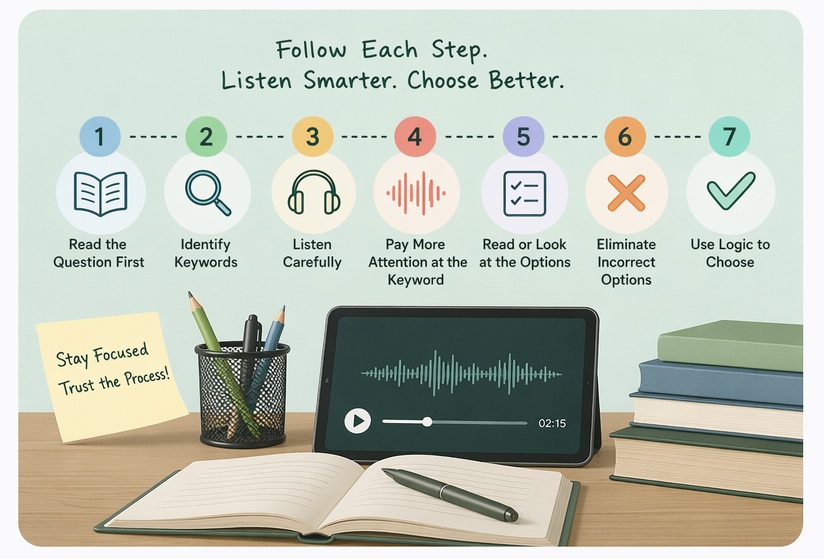
Step 1: Read the question first
Before the audio starts, read the question carefully. Focus on understanding what it is asking. Do not spend time reading the options yet. Your goal is to know what information you need to find.
Step 2: Identify the keywords
Look for the important words in the question. These are the words that tell you what the topic is and what you should listen for. Keywords help you recognize when the speaker is talking about the relevant part of the audio.
Step 3: Listen carefully
When the audio starts, focus on understanding what the speaker is saying. Do not panic if you do not understand every word. Try to follow the general meaning and stay focused from the beginning.
Step 4: Pay more attention when you hear the keyword
When you hear a keyword or something related to it, increase your attention. This is usually the part of the audio where the answer appears. The answer is often given just before or just after this moment, so you need to listen very carefully.
Step 5: Read or look at the options
After listening, look at the answer options. Compare them with what you heard in the audio. Do not choose immediately. Take a moment to think about which option matches the meaning.
Step 6: Eliminate incorrect options
Try to remove one or more options that are clearly wrong. Some options may sound similar, but they do not match the speaker’s main idea. Eliminating wrong answers makes it easier to choose the correct one.
Step 7: Use logic to choose the best answer
From the remaining options, choose the one that best fits the meaning of the audio. Make sure your choice is based on what the speaker actually said, not just on familiar words.
By following these steps, you can stay more focused and reduce common mistakes. The key is to listen carefully, recognize important moments in the audio, and make your decision based on meaning.
Guide 2: Note Completion
This section explains how to approach gap fill listening tasks step by step. The goal is to help you listen for specific information and write accurate answers.
Step 1: Read the sentence first
Before the audio starts, read the sentence carefully. Focus on understanding the overall meaning. Pay attention to what kind of information is missing.
Step 2: Identify the keywords and the gap context
Look at the important words before and after the gap. These words tell you the topic and help you understand what kind of answer is needed. They also help you recognize when the relevant part of the audio begins.
Step 3: Listen carefully
When the audio starts, focus on understanding what the speaker is saying. Do not try to write immediately. First, follow the meaning and stay focused.
Step 4: Pay more attention when you hear the keyword
When you hear a keyword or something related to it, increase your attention. This is usually the part where the answer appears. The answer is often given just before or just after this moment, so you need to listen very carefully.
Step 5: Write the answer
Write the word or phrase you hear that completes the sentence. Make sure it fits grammatically and matches the meaning of the sentence.
Step 6: Check accuracy
Check your answer carefully. Make sure:
the spelling is correct
the word form is correct
you have not written too many words
Step 7: Confirm during the second listening
Use the second listening to confirm your answers. Focus on the gaps you are not sure about and make corrections if needed.
By following these steps, you can improve your accuracy and avoid common mistakes. The key is to listen for specific information, use the context of the sentence, and check your answers carefully.